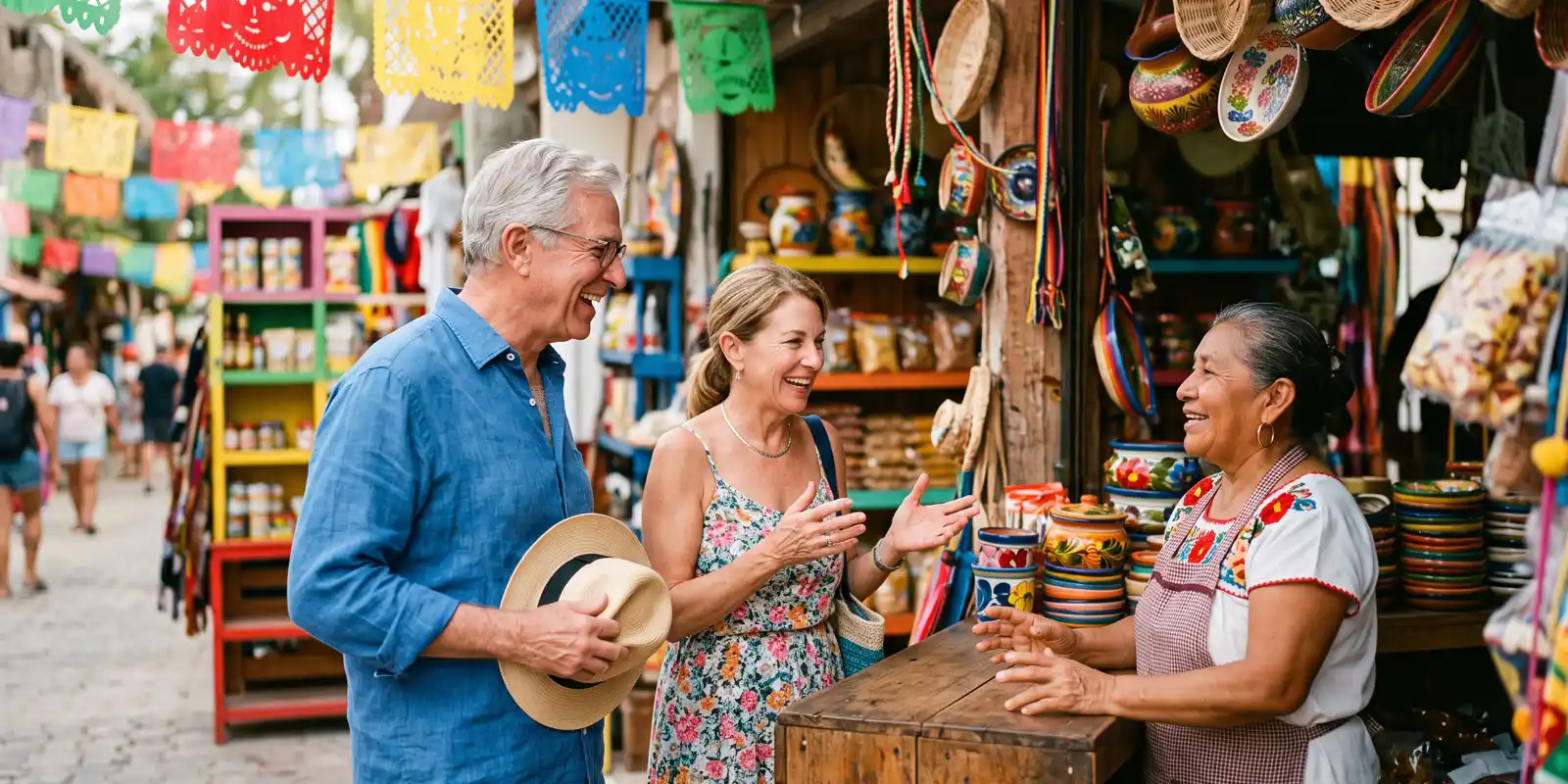
Why Most Expats Plateau at "Survival Spanish"
You know the plateau. You can order tacos, greet your neighbor, survive the OXXO line. Then someone answers you at full speed, or the conversation leaves the script — and you're smiling and nodding again.
This happens to expats all over Mexico, and it's not a talent problem. It's a structure problem. Survival Spanish is a collection of memorized phrases; real Spanish is a system you can improvise with. Phrases get you through transactions. They don't get you through a friendship, a landlord dispute, or a doctor's appointment.
Three habits keep the plateau in place:
- Living in the bubble. English-speaking friends, English-speaking services, English menus. Mexico makes it easy to never actually need Spanish — until you suddenly do.
- Input without output. Podcasts and apps feel productive, but listening alone doesn't build the muscle of forming sentences under pressure, in real time, with a real person waiting.
- No feedback loop. Without correction, the same five errors fossilize. You get faster at saying things slightly wrong.
The fix isn't more phrases. It's a program that moves you level by level from "I can order" to "I can argue, joke, and negotiate" — with a clear map of what comes next.
What Actually Works: Structure Plus Real-Life Tasks
After teaching languages since 2019, we've seen what separates expats who break through from those who stall for years. Two ingredients, together:
1. A structured route with real levels. Idiomarcui's program runs 7 levels, 60 class hours each, over 16 weeks per level, aligned with the CEFR — the international framework for language proficiency. Levels matter because they answer the question apps never do: where am I, and what exactly do I work on next? Progress is measured by what you can do with Spanish — not by streaks or grammar trivia.
2. Task-based practice with real materials. There are no textbooks. Classes are built around tasks you actually face living in Mexico: reporting a leak to your landlord, reading your CFE bill, describing symptoms at a pharmacy, handling a bank appointment. Grammar shows up the moment you need it to complete the task — which is exactly when it sticks.
Apps aren't useless — they're fine as a supplement. But an app can't watch you freeze mid-sentence and hand you the scaffolding to recover. A trained teacher can. That's the communicative approach: the four skills — speaking, listening, reading, writing — worked together, the way real life mixes them.
And yes, you study. We run a flipped-classroom model: you review structures on your own before class, so class time goes to speaking, not lectures. There's no shortcut around effort — just a smarter place to spend it.
Ready to actually speak?
Take the placement test and start at exactly your level. In person in Playa del Carmen or Tulum, or live online.
Book your free trial classIn Person or Live Online: It Works From Anywhere in Mexico
Idiomarcui has campuses in Playa del Carmen and Tulum — but you don't have to live in the Riviera Maya to join. Every course also runs as live online classes: synchronous sessions with a real teacher and real classmates, not pre-recorded videos you abandon by week three.
That means the same structured program works whether you're in Mexico City, Mérida, Oaxaca, San Miguel de Allende, Puerto Vallarta — or splitting your year between Mexico and somewhere else entirely.
How to choose your mode:
- In person if you're near Playa del Carmen or Tulum and want the energy of a classroom — role-plays, debates, and classmates who become your first Spanish-speaking social circle.
- Live online if you're anywhere else in Mexico, or your schedule demands flexibility. Same teachers, same method, same levels.
- Both, honestly: many students switch modes as life moves — in person while home, online while traveling — without losing their place in the program.
The online format uses the same task-based classes, plus AI tools worked into the course: role-play chatbots for low-stakes speaking practice and speech-recognition feedback on your pronunciation. You make your mistakes in private first, then with confidence in public.
Start at Your Real Level: The Free Placement Test
Most expats in Mexico aren't beginners — they're uneven. Great at restaurant Spanish, lost in a phone call. Solid vocabulary, shaky past tense. Starting from zero would bore you; starting too high would sink you.
That's why everything begins with a free placement test. It's quick, it's honest, and it places you in the right one of the 7 levels — including straight into intermediate or advanced if you've already built a base from years of living here.
The route itself is roughly this:
- Beginner levels: resolve immediate needs — introduce yourself, handle everyday exchanges, read simple texts and signs.
- Intermediate levels: fluency and argument — detailed conversations, real opinions, formal written messages to a landlord or a government office.
- Advanced levels: precise, natural command — debates, movies and podcasts without subtitles, professional reports and negotiation.
And the full route is not mandatory. If your goal is confident daily life rather than boardroom Spanish, take the levels that get you there and stop when you're satisfied. The program serves your goal — not the other way around.
A Route Built for People Who Move Around
Expat life in Mexico isn't linear, and a rigid program breaks the first time your life does. So the route is built to bend:
- Pause and resume. Flying home for six weeks? Visa run? Work exploding? Pause, then pick up exactly where you left off — no penalty, no starting over.
- Switch between in-person and online. Your level travels with you.
- Group options that fit real lives: general adult groups, executive scheduling for people who work, and dedicated groups for teens and kids — because if you moved here with family, everyone needs Spanish, not just you.
The pricing is built for real budgets too, published in pesos because that's what you actually pay in: $1,200 MXN enrollment (one time) and $1,400 MXN per month. No textbook fees — there are no textbooks. No materials packages. The placement test and trial class are free, so you know exactly what you're getting before spending a peso.
If you're specifically in the Riviera Maya, we've written dedicated guides to learning Spanish in Playa del Carmen and Tulum, plus a comparison of online versus in-person classes — worth a read if you're weighing modes. This guide is the wide view; those go street-level.
Your First Step: A Trial Class, Not a Commitment
Here's the shortest honest path from reading this to actually speaking better Spanish:
- Step 1: Reach out on WhatsApp at +52 984 879 0117. English is fine — obviously.
- Step 2: Take the free placement test. Fifteen minutes, and you'll know exactly where you stand on the 7-level map.
- Step 3: Sit in on a trial class — in person in Playa del Carmen (984 879 0117) or Tulum (984 198 2768), or live online from anywhere in Mexico — and judge the method with your own eyes.
- Step 4: If it clicks, enroll: $1,200 MXN once, $1,400 MXN monthly, and you're in.
Idiomarcui teaches 5 languages, and Spanish for foreigners is taught by instructors with real training in language teaching — not just native speakers winging it. The mission since 2019 has been the same: real communication, learned by doing.
The plateau doesn't break itself. But with structure, real tasks, and a teacher who catches what apps miss, it breaks faster than most expats expect — and Mexico stops being a place you live next to and becomes a place you live in.
Your free trial class is waiting
Visit the school, take your placement test and see why at Idiomarcui you speak from day one.
Book your free trial classFrequently asked questions
What are the best Spanish lessons for expats living in Mexico?
The lessons that work combine a structured, level-based program with real-life task practice — not apps alone. Look for CEFR-aligned levels, a placement test, and classes built around situations you actually face: landlords, pharmacies, bills, real conversations.
Can I take structured Spanish lessons if I don't live in Playa del Carmen or Tulum?
Yes. Idiomarcui's courses run as live online classes with a real teacher and classmates — the same 7-level program as in person. Students join from anywhere in Mexico, and many switch between online and in-person modes as they travel.
Why do I still struggle with Spanish after years in Mexico?
It's usually structure, not talent. Survival phrases plateau because there's no level-by-level progression, no speaking practice under pressure, and no feedback correcting fossilized errors. A placement test plus a structured route breaks the cycle.
How much do Spanish lessons for expats cost at Idiomarcui?
Tuition is $1,400 MXN per month plus a one-time $1,200 MXN enrollment fee, in person or live online. There are no textbook or materials fees, and the placement test and trial class are free. All prices are in Mexican pesos.
Do Spanish apps work for expats in Mexico?
Apps work as a supplement — vocabulary review, listening reps — but not as your main method. They can't correct you mid-sentence or push you to speak under real-time pressure, which is exactly the skill expats need. Combine app practice with live, task-based classes.