How much Spanish do you actually need to get hired?
It depends on the job, and being honest about that will save you months. In the Riviera Maya there are three broad tiers:
- English-friendly jobs (dive shops, tour sales, front desk at international hotels, remote work): you can get hired with basic Spanish, but you will still need it for coworkers, suppliers and half of daily operations.
- Mixed jobs (restaurant management, real estate, wellness, teaching): employers expect functional conversational Spanish. Interviews often happen partly in Spanish precisely to test you.
- Local-market jobs: fluent working Spanish is non-negotiable, from the first phone call.
Here is the part most expats underestimate: even for the first tier, the candidate who greets in Spanish gets remembered. Hiring managers in Playa del Carmen and Tulum see foreigners every week who promise they will "pick up Spanish later." The one who already handles a basic conversation signals commitment to staying, and that matters to an employer deciding who is worth training.
One practical note before anything else: to be employed in Mexico you need an immigration status that permits work. Rules change and depend on your situation, so verify the current requirements with official sources or a qualified professional. This guide covers the language, not the law.
Job-search vocabulary: reading listings and asking around
Mexican job listings use a compact vocabulary that repeats everywhere. Learn these and postings stop being a wall of text:
- Vacante (bah-KAHN-teh) — job opening. Puesto — position.
- Solicitud (soh-lee-see-TOOD) — application. Requisitos — requirements.
- Sueldo (SWEL-doh) — salary. Prestaciones — benefits, a word you want to see.
- Tiempo completo / medio tiempo — full time / part time. Turno — shift.
- Experiencia comprobable — verifiable experience. Disponibilidad inmediata — available to start now.
And the phrases for the search itself, because in Mexico many jobs still travel by word of mouth and a printed sign that says Se solicita (now hiring):
- Estoy buscando trabajo. (ehs-TOY boos-KAHN-doh trah-BAH-hoh) — I am looking for work.
- ¿Tienen alguna vacante? — Do you have any openings?
- ¿Puedo dejar mi solicitud? — May I leave my application?
- ¿Con quién puedo hablar sobre el puesto? — Who can I speak with about the position?
- ¿Cuándo me darían una respuesta? — When would I hear back?
Walking into a business with a printed CV and one confident Buenos días, ¿tienen alguna vacante? still works remarkably well on the coast, especially in hospitality.
Ready to actually speak?
Take the placement test and start at exactly your level. In person in Playa del Carmen or Tulum, or live online.
Make your next interview happen in Spanish — Book your free trial classInterview phrases that land well in Spanish
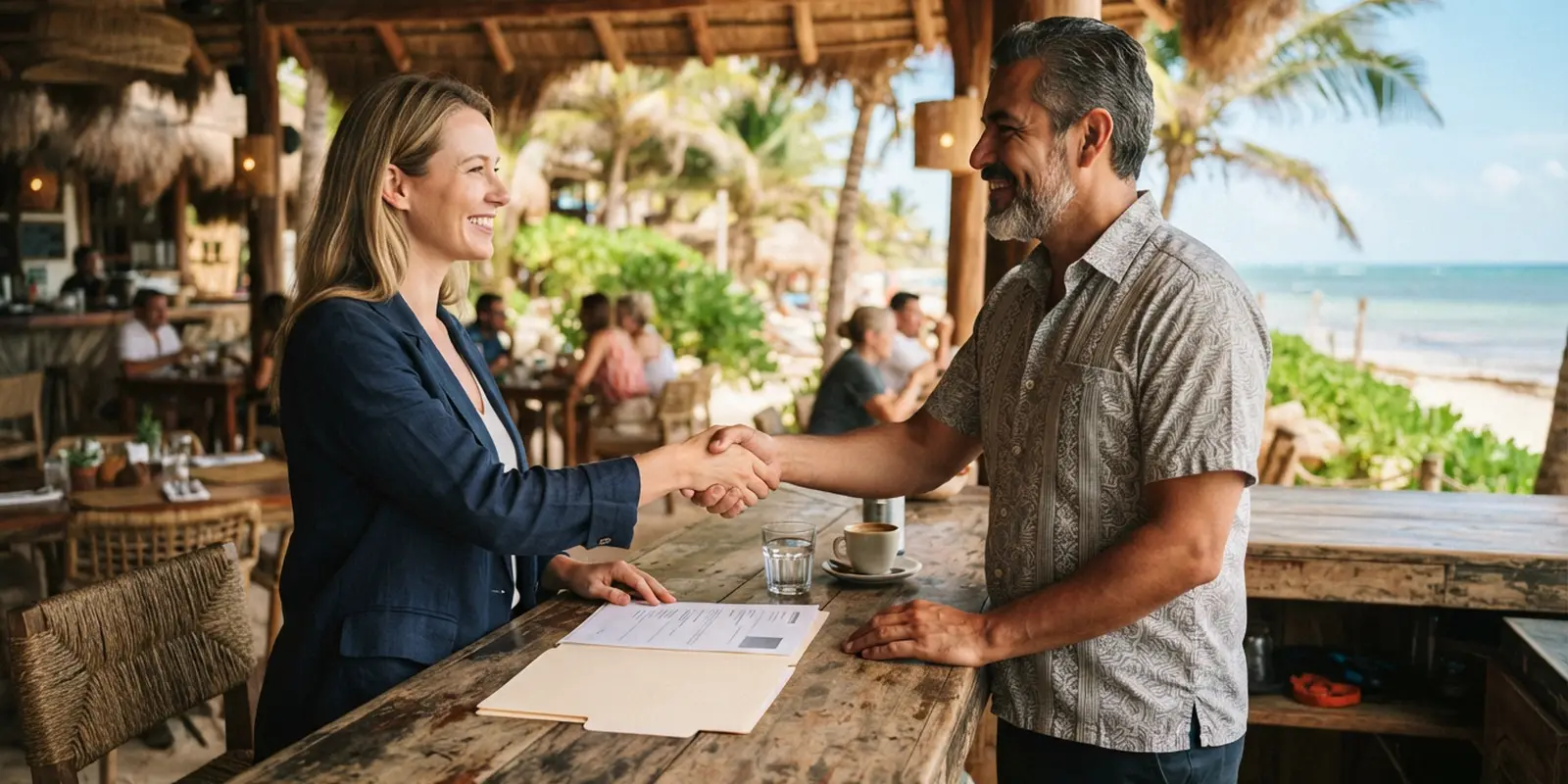
A Mexican job interview usually starts warmer than you may expect: a handshake, a mucho gusto (nice to meet you), sometimes small talk about where you are from. Match the warmth, then be ready with these:
- Gracias por recibirme. — Thank you for seeing me.
- Tengo experiencia en ventas y atención al cliente. — I have experience in sales and customer service. Swap in your field: cocina (kitchen), turismo, administración, enseñanza (teaching).
- Trabajé cinco años en un restaurante en Canadá. — I worked five years at a restaurant in Canada.
- Estoy aprendiendo español y mejoro cada semana. — I am learning Spanish and improving every week. Honest and it lands far better than pretending.
- ¿Cuáles serían mis responsabilidades? (KWAH-lehs seh-REE-ahn) — What would my responsibilities be?
- ¿Cómo es el horario? — What is the schedule like?
- ¿Cuándo podría empezar? — When could I start? And its best answer: Tengo disponibilidad inmediata.
Two rescue phrases will carry you through any gap: ¿Puede repetir, por favor? (can you repeat, please?) and No entendí la última parte. (I did not catch the last part). Using them calmly shows exactly the composure employers want in front of customers.
Usted or tu? Work culture basics with Mexican employers
Spanish has two ways to say "you," and in a job context the choice sends a message. Usted is the formal, respectful form; tú is the familiar one. The working rule for job seekers:
- Use usted with interviewers, bosses, older colleagues and clients, from the first hello: ¿Cómo está usted? rather than ¿Cómo estás?
- Wait to be invited to switch: many Mexicans will say háblame de tú (speak to me informally) once rapport is built. Until then, usted costs you nothing and earns you points.
- Titles matter in Mexican work culture: licenciado/licenciada for degree holders and managers, ingeniero for engineers, doctor, or simply señor/señora plus the last name.
Beyond grammar, a few cultural notes that shape hiring decisions: greetings are personal, so greet everyone in the room individually when you arrive. Relationships come before transactions, meaning the small talk at the start of an interview is not filler, it is the interview. And courtesy formulas are used constantly: con permiso (excuse me, when passing or leaving), propio or adelante in reply, que le vaya bien (have a good day) on the way out.
None of this requires advanced Spanish. It requires the right 30 expressions used with a genuine smile, which is exactly why employers read basic-but-courteous Spanish so favorably.
CV and paperwork terms you will hear again and again
Once an employer gets serious, a new vocabulary appears. Knowing it keeps you from nodding blankly at the exact moment you should look reliable:
- Currículum or CV — your resume. In Mexico it commonly includes a photo and personal details, a different convention than in the US or Canada.
- Carta de recomendación — reference letter. Mexican employers ask for these often, so line yours up early.
- Comprobante de domicilio — proof of address, typically a utility bill. Requested for almost any formal process.
- Contrato — contract. Nómina (NOH-mee-nah) — payroll; being en nómina means formally employed.
- RFC — your Mexican tax ID. CURP — a unique national identity code. IMSS — the social security institute that formal employment enrolls you in.
- Aguinaldo — the year-end bonus that formal jobs in Mexico pay by law.
Useful sentences for this stage: Aquí tiene mi currículum. (here is my CV), ¿Qué documentos necesitan? (what documents do you need?), and ¿El puesto es con contrato y prestaciones? (does the position include a contract and benefits?). That last question, asked politely in Spanish, marks you as someone who understands how formal employment works here, and it protects you too. For anything involving visas and work permissions, again: confirm the current rules through official channels for your specific case.
How to get your Spanish job-ready, fast and for real
Everything above is learnable from a page. What a page cannot give you is the moment the interviewer answers back at natural speed and your mind goes blank. The fix for that is not more vocabulary, it is practice under realistic pressure.
That is exactly how Spanish for foreigners works at Idiomarcui, a language school founded in 2019 with campuses in Playa del Carmen and Tulum plus live online classes. Classes run on a communicative, task-based approach: you rehearse real scenarios, introducing yourself to an employer, handling interview questions, asking about schedules and contracts, through role plays and real-life materials instead of textbooks. AI chatbots let you rehearse the stressful conversations in private, with role-play scenarios and pronunciation feedback, so mistakes happen in the classroom rather than in the interview.
The program has 7 levels of 60 hours each, taught over 16 weeks per level, with a free placement test so you start exactly at your level, in small groups, in person or online. Many students combine study with work schedules on the coast. The trial class is free, and one hour is enough to tell whether this is the push your job search needs.
Your free trial class is waiting
Visit the school, take your placement test and see why at Idiomarcui you speak from day one.
Make your next interview happen in Spanish — Book your free trial classFrequently asked questions
Do I need to speak Spanish to get a job in Mexico?
For many tourism-facing jobs in places like Playa del Carmen you can start with basic Spanish, since customers speak English. But coworkers, suppliers and daily operations run in Spanish, and employers consistently prefer candidates who already handle a basic conversation, because it signals they plan to stay and can grow into the role.
What Spanish phrases should I know for a job interview in Mexico?
The core set: Gracias por recibirme (thank you for seeing me), Tengo experiencia en (I have experience in), ¿Cuáles serían mis responsabilidades? (what would my responsibilities be?), ¿Cómo es el horario? (what is the schedule?), and Tengo disponibilidad inmediata (I can start right away). Add ¿Puede repetir, por favor? as your rescue phrase.
Should I use usted or tu with a Mexican employer?
Use usted, the formal you, with interviewers, bosses and clients from the first greeting. Many Mexicans will later invite you to switch by saying háblame de tú, and until that happens, usted always reads as respectful. Using tú too early with a hiring manager can come across as overly familiar.
Can a foreigner legally work in Mexico?
Yes, with an immigration status that permits work, such as the appropriate residency. Requirements depend on your nationality and situation and rules change, so verify current conditions with official Mexican immigration sources or a qualified professional before accepting a job. Employers hiring formally will ask about your status early.
Where can I learn job-ready Spanish in Playa del Carmen or Tulum?
Idiomarcui teaches Spanish for foreigners in Playa del Carmen and Tulum, plus live online classes. Founded in 2019, it uses a communicative, task-based approach with role plays of real situations like interviews, in small groups across 7 levels of 60 hours each, with a free placement test and a free trial class to start.