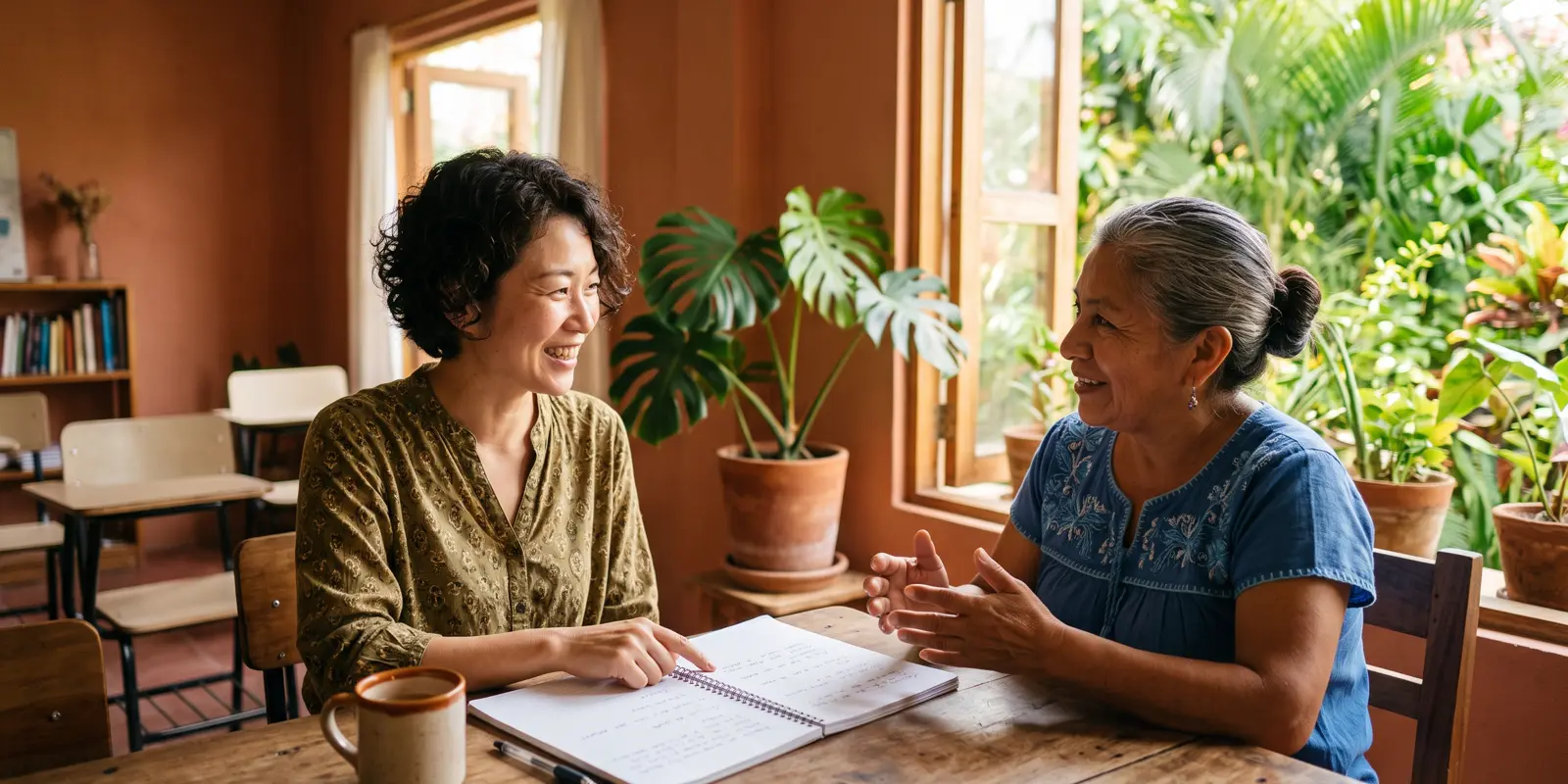
The "too old" myth, and what the research actually says
Let's deal with the fear directly, because it stops more people than grammar ever will: "I'm too old for this. My brain doesn't work that way anymore."
Here's what's true. Research on the so-called critical period shows that children exposed to a language early are far more likely to end up with a native-like accent and effortless grammar intuitions. That's the entire kernel of truth, and notice what it's about: sounding native. It is not about the ability to learn, communicate, read, joke, negotiate or build friendships in a new language. Adults do all of that successfully, at every age, all over the world.
What the myth leaves out is that adults are, in several measurable ways, better learners. You understand grammar as a concept instead of absorbing it blindly. You can study strategically, notice your own errors, and connect new vocabulary to decades of knowledge. A 55-year-old who hears the word jubilación (retirement) attaches it instantly to a rich, personally relevant concept; a teenager files it under "boring word, test on Friday."
There's also a quieter reason to start that has nothing to do with fluency. Learning a language is one of the most engaging workouts you can give an aging brain: sustained attention, memory retrieval, pattern recognition and social interaction, all in one activity. Researchers studying cognitive aging consistently point to exactly this kind of demanding, social, novel learning as the sort of activity worth building into later life. You don't need to overstate the science to act on it: the downside is zero and the upside is a second language.
Your real advantages after 50 (they're bigger than you think)
Older learners walk in with assets younger students would envy. Worth naming them, because most people over 50 walk in counting only their deficits.
- You know why you're doing this. A high-schooler learns Spanish to pass a class. You're learning it to talk to your neighbors, handle your own doctor's appointment, and belong in the place you chose to live. That kind of motivation is the single best predictor of who actually sticks with a language.
- You have discipline. Decades of showing up, for work, for family, for commitments, transfer directly. Language learning rewards consistency over brilliance, and consistency is a skill you've already mastered.
- You have time. Retired or semi-retired expats can give Spanish the one resource younger learners never have enough of. Two focused hours spread across a week beats the cramming schedule of any busy 30-year-old.
- You have vocabulary hooks everywhere. Every Spanish word attaches to something you already know deeply. And thousands of Spanish words are cognates you can recognize on sight: importante, familia, medicina, restaurante.
- You've stopped caring what strangers think. Not everyone, not entirely, but many people past 50 report exactly this, and it happens to neutralize the single biggest obstacle in adult language learning: the embarrassment of being a beginner in public.
None of this is a pep talk. It's an inventory. The question was never whether you have what it takes; it's whether you'll use what you already have.
Ready to actually speak?
Take the placement test and start at exactly your level. In person in Playa del Carmen or Tulum, or live online.
It's not too late — book your free placement test and see for yourselfWhat honestly gets harder, and how to work around it
Respect means telling you the whole truth, so here are the three real changes, each with a workaround that works.
1. New vocabulary needs more repetitions to stick. Rote memorization gets slower with age; this is real and universal. The workaround is to stop relying on rote. Spaced repetition, seeing a word again just before you'd forget it, and immediate real-world use are dramatically more effective than drilling lists. Learn aguacate in class, buy avocados at the mercado that afternoon, and the word is yours. In the Riviera Maya, that same-day-use loop is available for almost everything you learn.
2. Fast speech and noisy rooms are harder to parse. Age-related changes in hearing make a loud restaurant genuinely more difficult, in any language. Workarounds: learn the rescue phrases early and use them without shame, ¿puede repetir, por favor? and más despacio, por favor are not confessions of failure, they're tools. Practice listening in quiet settings first, and if you wear hearing aids, sit close and face the speaker. Locals here are notably patient with anyone visibly trying.
3. Old learning wounds resurface. Many people over 50 were taught languages by memorization, red ink and public correction, and assume that's what a classroom still is. It isn't, or at least it shouldn't be. Modern language teaching is built around tasks and conversation, ordering, explaining, asking, with grammar arriving when you need it. If a school hands you a conjugation workbook on day one and calls it a course, keep looking.
Notice what's not on this list: the ability to learn. That one's intact.
Why the Riviera Maya is a near-perfect place to do this
If you're reading this from Playa del Carmen, Tulum or anywhere along the coast, you have a structural advantage over every 50-plus learner studying Spanish from Toronto or Denver: you live inside the practice field.
Every errand is a rep at exactly your level. The frutería is numbers and courtesy. The pharmacy is describing a problem. The taxi is small talk. The neighbor's morning buenos días is a free daily lesson in sounding warm. You don't need to schedule practice; you need to stop avoiding the practice already scheduled for you.
The community helps too. The Riviera Maya has one of Mexico's largest populations of foreign residents and retirees, which means two things. First, you will not be the only silver-haired beginner in the room, not even close. Second, the local service culture is genuinely accustomed to learners: patient, encouraging, and quick to celebrate any effort in Spanish. The stereotype of the impatient native speaker rolling their eyes barely exists here.
One warning, because it's the local trap: that same expat density makes it entirely possible to live years here inside an English bubble, and the bubble is most comfortable precisely for retirees with established expat social circles. English-speaking friends, English-speaking restaurants, English-speaking Facebook groups. Nothing wrong with any of it, except that the language of your daily life is a choice, and the bubble quietly makes it for you. The expats over 50 who end up bilingual are the ones who deliberately put structured Spanish, a class, a schedule, a commitment, into the week, and let the town do the rest.
A realistic plan for starting after 50
Here's a plan with no heroics in it, which is exactly why it works.
- Start with a placement test, even from zero. Most people who've lived here a while know more Spanish than they think, absorbed from menus, signs and a hundred small transactions. Knowing your real starting point beats guessing. Ours is free.
- Choose consistency over intensity. Two 2-hour sessions per week, the standard in-person format at our school, is the rhythm that fits how memory consolidates: spaced, repeated, sustainable. An intensive blitz feels productive and evaporates.
- Close the loop the same day. Whatever you learned this morning, use it before dinner. This one habit, more than any method or app, separates the people who learn from the people who collect notebooks.
- Protect the streak, not perfection. Miss a class, misconjugate a verb, blank on a word you knew yesterday: all normal at every age. The only real failure mode is stopping. If you travel, pause and resume; a flexible program should allow exactly that.
If you want the structured piece, this is what we do. Idiomarcui is a language school founded in 2019 with campuses in Playa del Carmen (Calle 72) and Tulum, teaching Spanish for foreigners alongside four other languages. The program is organized in 7 levels of four-month modules, you take only what you need, with in-person, Saturday (4-hour) and live online formats. Enrollment is $1,200 MXN, monthly tuition $1,400 MXN, and there's a trial class, so you can sit in a room, feel the pace, and discover that the beginner's seat is a lot more comfortable at this age than you remember.
Your free trial class is waiting
Visit the school, take your placement test and see why at Idiomarcui you speak from day one.
It's not too late — book your free placement test and see for yourselfFrequently asked questions
Am I too old to learn Spanish at 50, 60 or 70?
No. The critical-period research behind the "too old" myth is about acquiring a native-like accent, not about the ability to learn and communicate. Adults at every age successfully learn Spanish; older learners bring motivation, discipline and time that younger students usually lack.
What actually gets harder about language learning with age?
Three things: new vocabulary needs more repetitions, fast speech in noisy places is harder to parse, and old classroom memories can resurface as anxiety. Each has a workaround: spaced repetition with same-day use, rescue phrases like "más despacio, por favor", and a task-based class instead of drills.
Is learning Spanish good for an aging brain?
It's one of the most complete mental workouts available: attention, memory retrieval, pattern recognition and social interaction in a single activity. Researchers on cognitive aging consistently recommend demanding, novel, social learning of exactly this kind, and the practical payoff is a second language.
How should someone over 50 study Spanish differently?
Favor consistency over intensity (two spaced sessions a week beat a weekend blitz), use every new word in real life the same day, practice listening in quiet settings before loud ones, and pick a school that teaches through conversation and tasks rather than memorization and red ink.
Where do I start in Playa del Carmen or Tulum?
Take a free placement test first, even if you believe you're at zero; most longtime residents know more than they think. Idiomarcui has campuses in Playa del Carmen (Calle 72) and Tulum, with in-person, Saturday and live online formats, and a trial class to feel the pace before committing.