Mexican Spanish is not a lesser version of Spanish
A lot of online courses teach a Spanish that is technically correct and practically foreign to where you live. If your daily life happens in Quintana Roo, learning to say vosotros or coger the way Madrid says it isn't neutral, it's actively unhelpful, and in the second case it's a word you should know not to use here.
The differences that actually matter day to day are less about grammar and more about texture:
- Vocabulary. Carro not coche. Jugo not zumo. Alberca not piscina. Dozens of these, and they're the words you use every single day.
- Politeness. Mexican Spanish is markedly more indirect and more courteous than most other varieties. Requests get softened, mande replaces qué, diminutives do enormous social work. Learning the words without learning this register makes you sound abrupt without meaning to.
- Rhythm. Speed and intonation differ by region, and your ear trains on whatever you listen to. If you train on Spain and then move to Playa, you'll understand your podcast and not your neighbor.
And on this coast there's a further layer: Quintana Roo Spanish carries Maya-influenced words woven into everyday speech. You'll hear them in markets and in casual conversation, and no general course contains them.
None of this means other varieties are wrong. It means the one you learn should be the one spoken around you, because the whole point is being understood by the people you actually talk to.
Live class or recorded course? The distinction hidden in the marketing
"Online Spanish course" covers two completely different products at wildly different prices, and the marketing rarely distinguishes them clearly.
A recorded course is video plus exercises. It's cheap, it's available at 3am, and it's genuinely fine for vocabulary and grammar concepts. What it cannot do is the thing that makes you conversational.
A live class has a teacher who responds to you. That difference is not a nicety, it's the mechanism. Specifically, a live teacher:
- Hears what you avoid. Learners quietly route around structures they don't master. A recording can't detect this; a teacher notices in two sessions.
- Corrects pronunciation in the moment. Repeating an error unchallenged for months makes it permanent.
- Responds unpredictably. Real conversation is improvisation. You can't rehearse it against a script.
- Calibrates difficulty live. Too easy and you coast; too hard and you shut down.
Before paying, ask three things and the format becomes obvious: Is the teacher live for the entire session? How many students are in the class? How much of the session will I be speaking? Vague answers to any of these usually mean you're buying recordings with a support chat.
Our online classes are synchronous, meaning a real teacher in real time, and they follow the same path and the same method as the in-person classes at our campuses. Online is a format here, not a lesser product.
What only a live teacher can do
The questions that reveal the format
Ready to actually speak?
Take the placement test and start at exactly your level. In person in Playa del Carmen or Tulum, or live online.
Take your free placement test and start live online classes with Mexican teachers — Book your spotWhat a good online session actually looks like
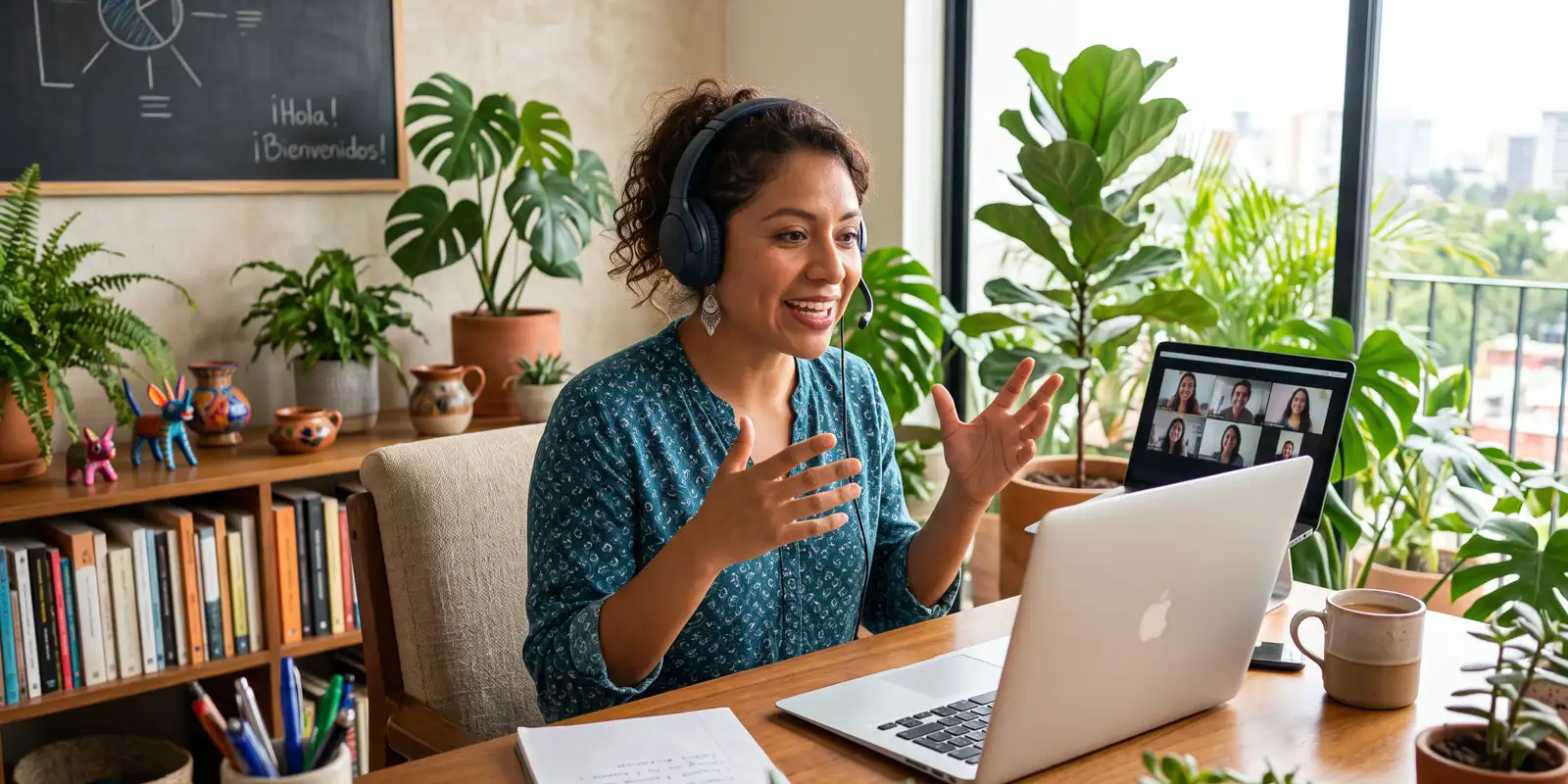
The failure mode of online language classes is a teacher sharing slides while students watch. That's a webinar. If you're paying for a class, you should be talking.
We organize sessions around task-based learning: each class forms around something you have to accomplish in Spanish rather than a grammar topic. Making an appointment, resolving a problem with a service, explaining a situation, negotiating something. The grammar shows up because the task requires it, which is why it sticks.
Two things make this work particularly well online:
Flipped classroom. Individual study of structures happens before the session with digital resources, so the live time, the expensive, irreplaceable part, goes entirely to interaction. Online sessions are where this matters most, because passive screen time is the easiest thing in the world to zone out of.
Real materials instead of textbooks. We don't use course books. Materials come from current life: articles, video, actual interactions. Online this is an advantage, since the teacher can put a real menu, a real listing, a real message on screen and work from it directly.
We also use AI chatbots with roles and speech recognition for pronunciation between sessions. For online learners this closes a real gap: you don't have classmates in the hallway to practice with, so having somewhere to rehearse privately, as many times as you want, matters more than it does for in-person students.
Does online actually work for Spanish?
Honestly: yes for most people, with two conditions that are worth being clear about.
It works if you speak during class. Format matters far less than speaking time. A live online class where you talk substantially beats an in-person class where you sit in a group of twenty and produce four sentences.
It works if you have somewhere to use it. This is the real variable. If you live in Mexico, you have the best practice environment available and online classes plus daily life is a strong combination. If you're learning from abroad before moving, you'll need to build exposure deliberately, because class alone is not enough contact hours.
Where online genuinely beats in-person: no commute, which in the Riviera Maya during high season is not a small thing; access to teachers regardless of where you live; and it survives travel. That last one is the quiet killer of language learning, people move, work trips happen, and in-person courses get abandoned. Online plus a path that lets you pause and resume is what keeps progress alive across a real life.
Where in-person still wins: group energy, incidental practice with classmates, and for some people the simple accountability of physically going somewhere.
Structure is the same either way: seven levels, each 60 hours of class across 16 weeks, and you take only the levels you need rather than the whole track.
How to start without wasting the first month
Take a placement test first, even if you're sure you're a beginner. People who have spent any time in Mexico almost always test higher than they expect, especially in listening. Starting at the wrong level costs money and motivation. Ours is free.
Be specific about your goal. "Learning Spanish" is not a target you can hit. "Handling a doctor's appointment alone" or "understanding my landlord without a translator" is, and it changes what your teacher prioritizes from day one.
Check your setup before the first class. Wired headphones with a mic beat laptop speakers by a wide margin. Audio quality directly affects pronunciation work, and it's the single most common avoidable problem in online classes.
Ask about flexibility before enrolling, not after. If you travel, or your work is seasonal, you need to know what happens when you miss three weeks. A path where you can pause and resume is what separates a course you finish from one you abandon.
We're a language center founded in 2019 in Playa del Carmen, with campuses in Playa del Carmen and Tulum, teaching Spanish for foreigners along with English, French, Italian and Mandarin. Our teachers are trained in language teaching, not simply native speakers, which with Spanish matters more than most people realize: knowing why you keep confusing ser and estar is a teaching skill, not a speaking one.
Your free trial class is waiting
Visit the school, take your placement test and see why at Idiomarcui you speak from day one.
Take your free placement test and start live online classes with Mexican teachers — Book your spotFrequently asked questions
Is Mexican Spanish different from Spanish in Spain?
Yes, in vocabulary (carro not coche, jugo not zumo), in politeness conventions and in rhythm. Mexican Spanish is notably more indirect and courteous. If you live in Mexico, learning the local variety means you're understood by the people around you.
Are online Spanish classes as good as in-person?
For most people yes, provided the class is live with a real teacher and you speak substantially during it. Speaking time predicts results far more than format. Online also survives travel and seasonal work, which is what usually ends in-person courses.
How do I know if a course is live or just recorded videos?
Ask three questions: is the teacher live for the whole session, how many students are in the class, and how much will you be speaking. Vague answers usually mean you're buying recordings with a chat channel attached.
Do I need a native speaker to learn Spanish?
You need a trained teacher more than you need a native speaker. Native fluency doesn't teach anyone how to explain ser versus estar or which errors to correct now and which to let pass so you keep talking. Ideally you get both.
How long are the online Spanish courses?
Each level is 60 hours of class across 16 weeks, within a seven-level path. You take only the levels you need for your goal and can pause and resume. A free placement test determines where you actually start.