The honest answer: it depends which Playa del Carmen you live in
There are two Playa del Carmens, and which one you live in determines your answer completely.
The first is the tourist corridor: Quinta Avenida, the beach clubs, the hotel zone, the coworking spaces. Here, English is genuinely enough. Servers, tour operators, dive shops and rental agents all work in English every day, and many of them speak it better than you'll expect. If your life happens inside a ten-block radius of the beach, you can go months without needing a full sentence in Spanish.
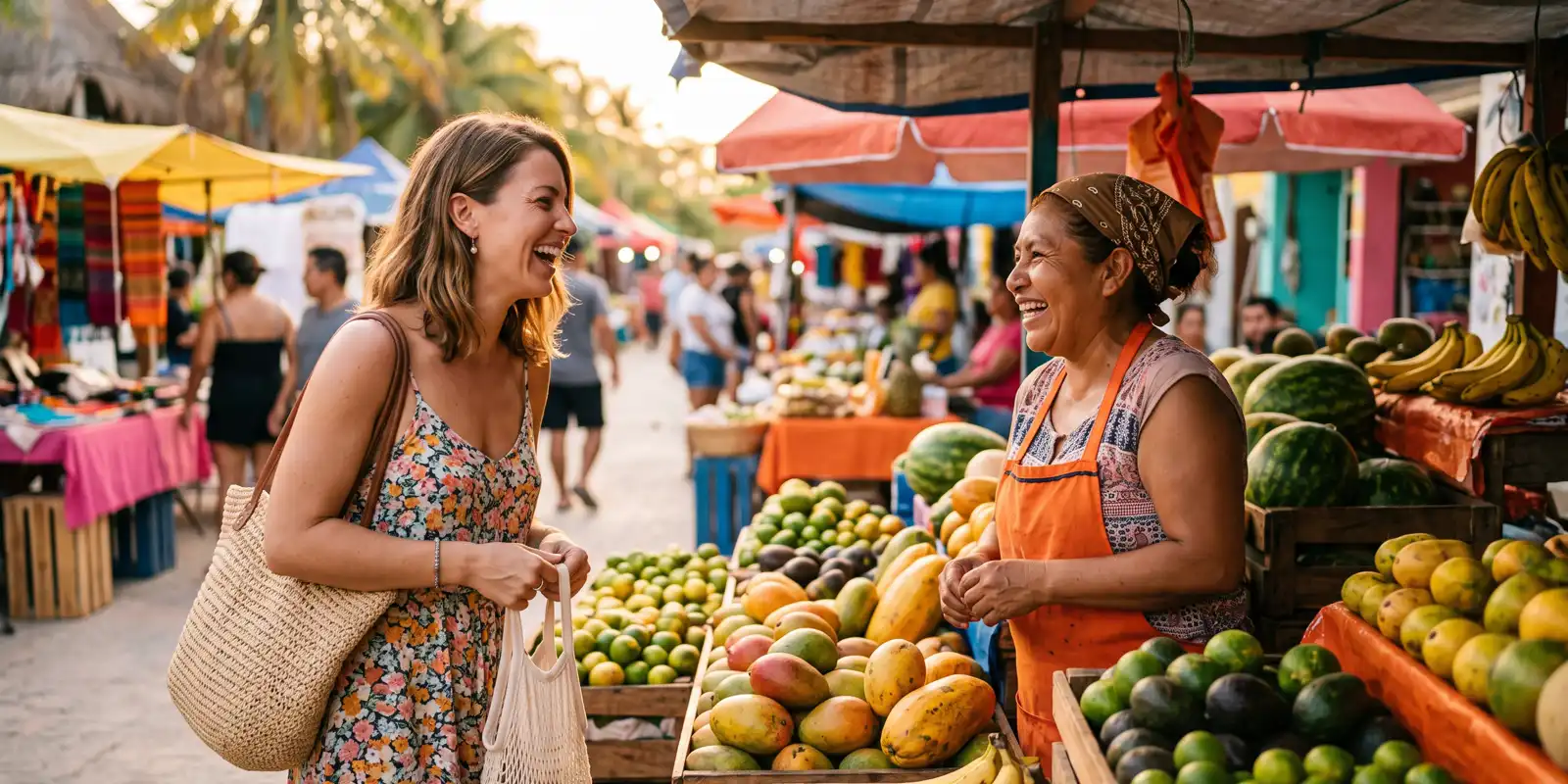
The second is the actual city where roughly 300,000 people live and work. Colonia Ejidal, Villas del Sol, the neighborhoods where the rent is half what you'd pay near the beach. The mechanic. The clinic that isn't the expensive international one. The tianguis on Saturday where produce costs a third of what the supermarket charges. The neighbor whose Wi-Fi router is the reason yours keeps dropping.
Here, English gets you nowhere, and this is not a small detail: it's the difference between living in Playa and living next to it.
Most people who move here start firmly in the first Playa and slowly discover the second one exists. That discovery usually happens through a problem: a plumbing emergency, a medical appointment, a dispute over a deposit. Those moments are memorable, and not in a good way, when you have no shared language.
Five situations where English stops working
1. Renting long-term. Furnished condos advertised in English on expat Facebook groups carry a foreigner premium, often 30–50% above local rates. The apartments listed in Spanish on local groups, or with a sign on the door, are where the real prices live. Reading a Mexican lease is another matter entirely: fiador, depósito, contrato de arrendamiento. Signing something you can't read is how people lose deposits.
2. Healthcare. The international clinics have English-speaking staff and international pricing. Local clinics and IMSS do not. In a real emergency, being able to say "soy alérgico a la penicilina" or "me duele aquí desde hace tres días" is not a language skill, it's a safety issue. This is the argument that convinces most expats to finally start classes.
3. Immigration and paperwork. INM appointments for your residency card, the bank, the CFE electricity office, getting an RFC. These are conducted in Spanish, by people processing a queue. You can hire a facilitator, and many do, but you'll pay for every visit and you'll never fully know what was said on your behalf.
4. Money and services. Every quote you get in English is a quote for a foreigner. The plumber, the mover, the guy who fixes your AC: prices shift when the conversation happens in Spanish. This is not malice, it's a universal market reality, and it's expensive when you're on the wrong side of it.
5. Actual friendship. This is the one nobody mentions in the relocation guides, and it's the one that matters most after year one. You can build a full social life here in English, entirely with other foreigners. Many people do. But it's a specific kind of life: transient, with people leaving every season, and always slightly outside the country you chose to live in. Speaking Spanish is what turns your neighbors into your neighbors.
Long-term housing
Bureaucracy
Friendship
Ready to actually speak?
Take the placement test and start at exactly your level. In person in Playa del Carmen or Tulum, or live online.
Take your free placement test and start speaking Spanish from your first class — Book your spotHow much Spanish is actually enough?
Here's the good news, and it's genuinely good: you do not need fluency. The goal that changes your daily life is much closer than most people assume.
Think of it in three practical stages:
- Survival Spanish (a few weeks of study). Greetings, numbers, directions, ordering, asking prices, basic courtesy. This gets you through daily transactions and, more importantly, it changes how people treat you. Effort is noticed here, and it's rewarded.
- Conversational Spanish (this is the real target). You can explain a problem, understand the answer, negotiate, handle a phone call, and follow a conversation that isn't about you. This is where Playa opens up: better prices, real friendships, a doctor's appointment you handle alone. For most expats, this is the destination, not fluency.
- Advanced Spanish. Humor, argument, subtlety, understanding the joke at the table without asking. Wonderful if you get there, but nobody needs it to live well.
In our framework at Idiomarcui, that conversational threshold sits in the intermediate range of a seven-level path. Each level is 60 hours of class spread over 16 weeks, and you're not required to do the whole journey: you take the levels you need, and you can pause and resume, which matters if you travel or your work is seasonal. A free placement test tells you where you actually start, because almost everyone who has lived here a while knows more than they think.
Why living here doesn't teach you Spanish by itself
This is the most common expat expectation, and it's the one that quietly fails. "I'll pick it up by living here" sounds obviously true and usually isn't. Plenty of people have been in Playa for eight years and still can't hold a five-minute conversation.
The reason is structural. Immersion only teaches you if you're actually immersed, and Playa del Carmen makes it remarkably easy not to be. Your building is full of foreigners. Your job may be remote and in English. The staff at every place you go switches to English the second they hear your accent, out of professional courtesy. You can be physically in Mexico and linguistically in an English-speaking bubble, indefinitely.
The second reason is harder to admit: speaking badly in public is uncomfortable. In language learning this is called the affective filter, and the research is consistent about it, anxiety is the main barrier to acquisition. When you're stressed about sounding foolish, your brain simply doesn't absorb the language, no matter how much of it is around you. So you avoid the situations that would teach you, and the avoidance compounds.
What breaks the cycle is a low-stakes place to be bad at Spanish before you have to be good at it in the real world. That's essentially what a class is for. We work through task-based learning, so sessions are built around real situations, calling a landlord, explaining symptoms, dealing with a delivery, using real materials from life in Playa rather than a textbook. We also use AI chatbots with roles for practice, which sounds gimmicky until you realize the appeal: you can fail a conversation twenty times in private, with no one watching, and walk into the real version already confident.
What we'd tell a friend who just moved here
Start before you need it. Almost everyone starts Spanish because of a crisis, a medical scare, a rental dispute, an immigration deadline. Learning under pressure is the worst possible condition, and it's completely avoidable.
Take classes with Mexican teachers, specifically. The Spanish spoken here is not the Spanish of a European app. Quintana Roo has its own pace, its own vocabulary, its own way of being polite. You want to learn the version people around you actually speak, including the Maya-influenced words woven into everyday speech on this coast.
Aim for conversational and stop worrying about perfect. The people who succeed here aren't the ones with the best grammar, they're the ones willing to be understood imperfectly, repeatedly, until it stops being imperfect.
And be realistic about the timeline. From zero to genuinely comfortable is a matter of months of consistent work, not weeks, and not years either. Sixty hours per level, sixteen weeks each, taking only the levels you need. That's a schedule you can actually plan your life around.
The expats who love living in Playa del Carmen five years in are, almost without exception, the ones who speak Spanish. That's not a coincidence, and it's not about the language itself. It's about whether the place where you live is a place you can fully participate in.
Your free trial class is waiting
Visit the school, take your placement test and see why at Idiomarcui you speak from day one.
Take your free placement test and start speaking Spanish from your first class — Book your spotFrequently asked questions
Can you live in Playa del Carmen without speaking Spanish?
Yes, many people do, especially in the tourist corridor near Quinta Avenida where English is widely spoken. But you'll pay foreigner prices, depend on others for paperwork and healthcare, and your social life will be limited to other expats. Survival is possible; comfort is not.
How much Spanish do I need to live comfortably in Playa del Carmen?
A conversational level is the realistic target, not fluency. That means explaining a problem, understanding the reply, handling a phone call and negotiating. At that point you can rent, see a doctor and make local friends independently.
Will I just pick up Spanish by living in Mexico?
Usually not. Playa del Carmen makes it easy to stay in an English-speaking bubble, and service staff often switch to English automatically. Plenty of long-term residents still can't hold a conversation. Structured practice is what makes immersion actually work.
How long does it take to reach conversational Spanish?
It depends on your starting point and consistency. At Idiomarcui each level is 60 hours of class over 16 weeks, and conversational ability sits in the intermediate range of a seven-level path. A free placement test shows exactly which levels you still need.
Is Mexican Spanish different from the Spanish taught in apps?
Yes, in vocabulary, pace and politeness conventions, and the Spanish of Quintana Roo has its own local flavor including Maya-influenced words. Learning with Mexican teachers means you practice the version actually spoken around you every day.