Why real conversation is the practice that actually counts
You can study Spanish for a year and still freeze when the plumber calls. That's not a knowledge problem; it's a practice problem. Studying builds what you know. Only conversation builds what you can do: retrieving words under time pressure, decoding real speed and real accents, recovering when you understand half a sentence.
Real conversations with locals train exactly the muscles apps and flashcards can't touch:
- Speed and unpredictability. Nobody at the mercado speaks textbook-clear at textbook pace. Your ear calibrates to reality only through exposure to reality.
- Recovery skills. Real fluency isn't understanding everything; it's staying in the conversation when you don't. ¿Cómo?, ¿puede repetir?, más despacio, por favor: these get trained in the wild, nowhere else.
- The emotional muscle. The main thing blocking most adult expats isn't grammar, it's the fear of sounding foolish. Every small successful exchange shrinks that fear a little. There is no substitute.
Here's the trap, though: living in Playa del Carmen doesn't automatically give you this practice. This town runs so smoothly in English that you can be here five years and never complete a Spanish sentence. Immersion isn't where you live. It's what you do, on purpose, every day. The rest of this article is the how.
Where practice happens naturally in Playa del Carmen and Tulum
The best practice venues share one feature: the conversation has a real purpose besides practice. You're buying something, asking something, greeting someone. That takes the pressure off both sides.
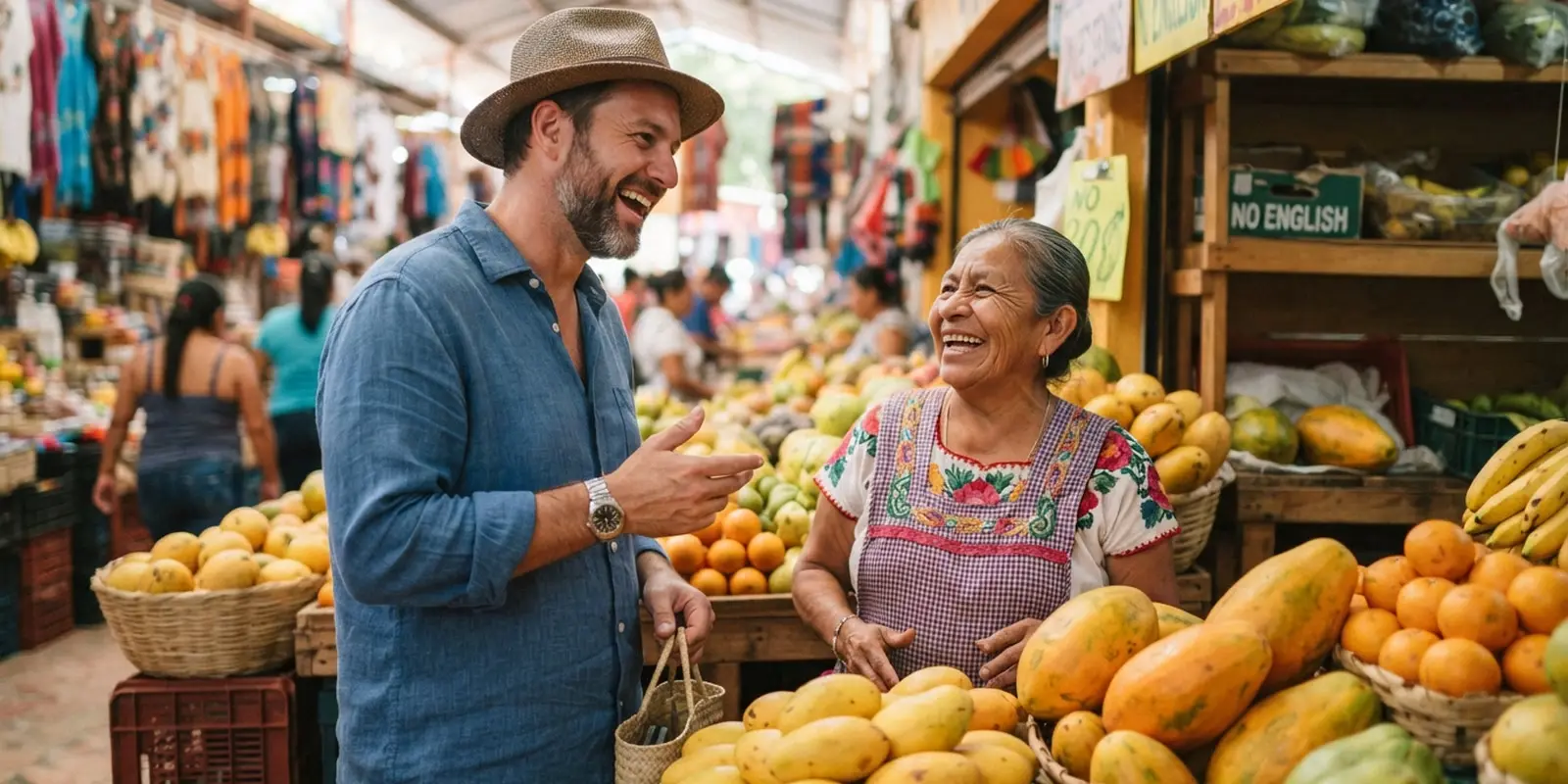
- The mercado and tienditas. Small transactions, patient vendors, built-in vocabulary (numbers, quantities, food), and the magic of being a regular: by week three, the fruit señora knows you, and regulars get real conversation. Shop at the same stalls deliberately.
- Your daily-orbit people. The barista, the OXXO cashier at 7 a.m., the security guard, the gym front desk. These micro-relationships come with daily, low-stakes, repeated contact, the exact structure language learning loves.
- Colectivos and taxis. A captive fifteen minutes with a local who often enjoys the chat. Drivers are famously good conversation, and the topics are beginner-friendly: where you're from, how long you've been here, the heat.
- Your actual neighbors. The single most underused resource. A consistent buenos días ripens into small talk, which ripens into being invited to the birthday party, which is where Spanish stops being a subject and becomes your life.
- Interest-based groups, not language-based ones. A local football game, salsa class, fishing trip, volunteer beach cleanup. Shared activity gives you things to talk about and people who talk to you as a person, not as a learner.
Cenote and beach small talk deserves a mention too: vendors and guides chat all day, and off-peak they often have time and patience for a slower conversation.
Ready to actually speak?
Take the placement test and start at exactly your level. In person in Playa del Carmen or Tulum, or live online.
Get the structure behind the street practice — take your free placement test and try a classThe reciprocity rule: locals are people, not free tutors
Time for the uncomfortable part, because getting this wrong is common and quietly resented.
Someone doing their job doesn't owe you a Spanish lesson. The waiter during the lunch rush, the cashier with a line behind you, the receptionist juggling phones: they'll be kind about your slow Spanish, because people here are remarkably generous, but stretching their workday into your practice session takes something without giving anything back. The unspoken transaction matters: their patience is a gift, not a service you're entitled to.
What reciprocity looks like in practice:
- Read the moment. Empty café at 4 p.m.: chat away. Friday rush: order, smile, gracias, done. The skill of noticing is itself a form of respect.
- Be a good customer first. Buy the fruit, tip well, come back. Practice rides on top of a real relationship, never instead of one.
- Give conversation, not just extraction. Ask about their day and listen to the answer. People can feel the difference between being talked with and being used as a language treadmill.
- Offer your own currency. Many locals in the Riviera Maya are actively improving their English for work. A genuine trade, you help with English emails, they correct your Spanish, is a real exchange between equals. One-directional "correct everything I say" is homework you've assigned a stranger.
- Accept the English reply gracefully. Sometimes people switch to English to practice their second language, or just to serve you efficiently. It's not rejection. ¿Te parece si yo hablo español y tú inglés?, half and half, is a lovely solution locals genuinely enjoy.
Scripts that open doors (and keep them open)
A handful of phrases reliably turn transactions into conversations. Deploy as needed.
- Estoy aprendiendo español, ¿podemos hablar en español? — "I'm learning Spanish, can we speak Spanish?" The master key. Said with a smile, it works almost every time, and people are surprisingly invested in helping once they know it matters to you.
- ¿Cómo se dice esto? — "how do you say this?", while pointing. Turns any object in any shop into a mini-lesson that takes five seconds of the other person's time.
- ¿Así se dice? / ¿Lo dije bien? — "is that how you say it? did I say it right?" Invites one correction without demanding a tutoring session.
- ¿Qué me recomienda? — "what do you recommend?" Works at every food stall and shop, hands the other person the expert role, and the answer is always comprehensible input about something you care about: your lunch.
- Perdón, ¿me enseña ese número? — when a price flies past you, asking to see the number keeps the interaction in Spanish instead of collapsing into English.
- Aquí vivo, no soy turista. — "I live here, I'm not a tourist." Watch the entire register of the conversation change.
And one habit worth more than any phrase: end conversations you started. A clean gracias, que tenga buen día leaves the door open for tomorrow. The goal isn't winning each conversation; it's becoming someone the neighborhood talks to. That compounds daily, and it's worth more than any app streak.
Street practice needs a spine: pair it with structure
Honest limitation time, because we'd rather be straight with you: street practice alone plateaus. It's the best polish in the world for Spanish you already have, but it rarely teaches you new structures. The mercado will make your numbers automatic; it will never explain why it's me gusta and not yo gusto, and strangers are far too polite to correct the error you've now repeated four hundred times. Fossilized mistakes, wrong forms cemented by uncorrected repetition, are the signature injury of practice-only learners.
The combination that actually works is a loop:
- Class gives you the new tool, past tense, a question structure, corrected pronunciation, in a room where being wrong is safe and someone's job is to fix it.
- The street makes it permanent. Learned the past tense Tuesday? Tell the fruit señora what you cooked with last week's mangoes. Same-day use is what moves things into long-term memory.
- The street sends questions back to class. Something you heard at the cenote made no sense? That's Thursday's first question for your teacher.
That loop is exactly how we structure Spanish for foreigners at our school: small in-person groups in Playa del Carmen (Calle 72) and Tulum, two two-hour sessions a week, task-based classes built around the real situations in this article, taught by teachers trained in language teaching, not just native speakers. There's a free placement test and a trial class, and between sessions your homework mostly looks like this: go talk to your neighborhood. It's the best classroom in town, and it's open every day.
Your free trial class is waiting
Visit the school, take your placement test and see why at Idiomarcui you speak from day one.
Get the structure behind the street practice — take your free placement test and try a classFrequently asked questions
How do I practice Spanish with locals without being annoying?
Attach practice to real interactions (buying, asking, greeting), read the moment, and never stretch someone's busy workday into a tutoring session. Be a good customer first, keep exchanges short during rushes, and let longer chats happen when the other person clearly has time.
Everyone answers me in English. How do I keep the conversation in Spanish?
Say "Estoy aprendiendo español, ¿podemos hablar en español?" with a smile, it works nearly every time. If they want to practice English, offer the trade: you speak Spanish, they answer in English. Both sides get practice and nobody loses the interaction.
Where in Playa del Carmen can I practice Spanish naturally?
The mercado and small tienditas, your daily-orbit people (barista, cashier, security guard), colectivo and taxi rides, your actual neighbors, and interest-based groups like sports, dance or volunteering. Regularity matters more than venue: become a familiar face.
Is a language exchange partner better than just talking to people?
A genuine trade, you help their English, they help your Spanish, is a fair exchange between equals and works well. But purpose-driven daily conversations usually beat scheduled exchanges because they're more frequent, lower pressure, and attached to real life.
Can I learn Spanish only by talking to locals, without classes?
You'll gain confidence and speed, but practice-only learners plateau and fossilize errors, since strangers are too polite to correct you. The effective loop is class for new structures and corrections, street for making them permanent, and back again.