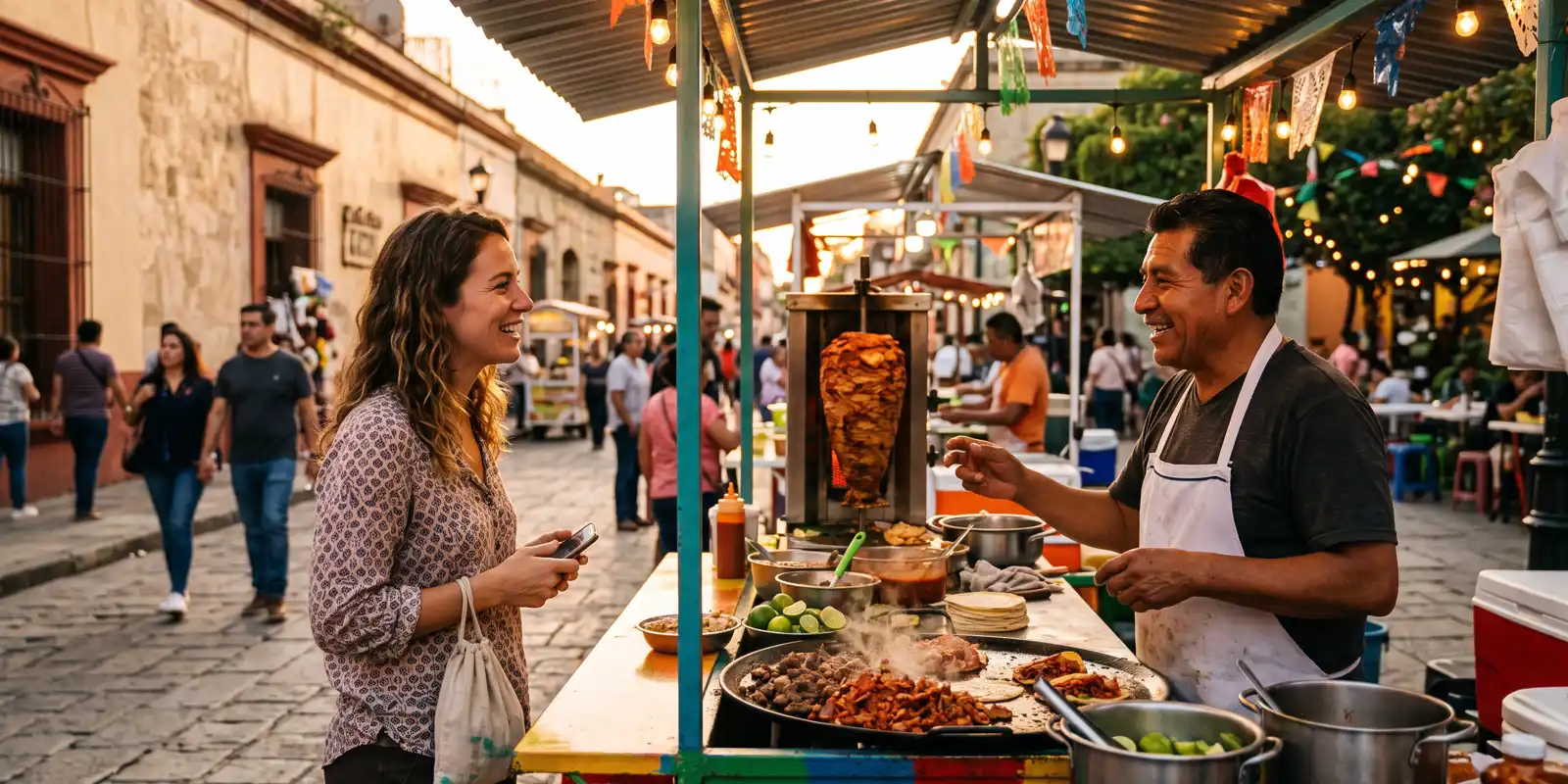
You have the best learning environment on earth, and you're probably wasting it
Here's the good news and the hard truth in one sentence: you live in the best possible place to learn Spanish, and statistically, you're not using it.
People pay thousands to travel to Mexico for "immersion programs." You have that immersion every single day, for free, permanently. The taco stand, the neighbor, the market, the plumber, the doctor: every interaction is a free lesson. No app or classroom can manufacture that volume of authentic exposure.
And yet the most common expat story is someone who has lived here five or eight years and still can't hold a conversation. How? Because proximity is not immersion. You can be physically in Mexico and linguistically in an English-speaking bubble, indefinitely:
- Your building is full of other foreigners.
- Your work is remote and in English.
- Every server, vendor and rental agent switches to English the second they hear your accent, out of professional courtesy.
So the environment is there, but it doesn't teach you automatically. The best way to learn Spanish in Mexico isn't a secret technique, it's a deliberate decision to actually use the extraordinary resource around you, with enough structure to turn exposure into ability. That combination is the whole answer, and the rest of this explains how.
Why immersion alone fails (and why classes alone are slow)
Two approaches fail on their own, and understanding why points to what works.
Immersion alone fails for two reasons. First, the bubble: as above, Mexico makes it remarkably easy to avoid Spanish entirely. Second, and less obvious, is anxiety. There's consistent research showing that stress acts as a filter that blocks language acquisition. Speaking badly in public is uncomfortable, so you avoid the very situations that would teach you, and the avoidance compounds. Immersion only teaches the people who push through that discomfort, and most people don't, not without help.
Classes alone are slow because a few hours a week, however good, can't provide enough contact hours to reach fluency on their own. A classroom is where you learn the tools; you still need to use them thousands of times to make them automatic. An expat who takes classes but never speaks Spanish outside them plateaus quickly.
Now put them together and each fixes the other's flaw:
- Classes give you the structure, correction and confidence to break out of the bubble.
- Daily life gives you the practice volume that classes can't.
You walk into the taco stand having rehearsed the interaction in class, so you actually attempt it in Spanish instead of defaulting to English. That single behavioral change, repeated daily, is what turns living in Mexico into learning Spanish.
The bubble problem
The structure problem
Ready to actually speak?
Take the placement test and start at exactly your level. In person in Playa del Carmen or Tulum, or live online.
Take your free placement test and turn living in Mexico into speaking Spanish — Book your spotThe method that works when the language is all around you
The most effective approach for someone who lives here has a specific shape, different from someone learning from abroad.
Learn what you'll use today, not the textbook order. This is why we don't use textbooks. We build classes around task-based learning: each session forms around a real situation you have to handle, calling a landlord, explaining symptoms, ordering, negotiating, so the Spanish you learn on Tuesday is the Spanish you use on Wednesday. When your practice environment is your actual life, aligning class content with that life is a huge accelerator.
Learn the Spanish that's actually spoken around you. Learn from Mexican teachers, and specifically for this coast, teachers who know Quintana Roo Spanish, which has its own pace, vocabulary and Maya-influenced words you'll hear daily and find in no European app. Learning the wrong variety means translating twice.
Rehearse before you perform. The affective filter is the biggest obstacle for adult learners, so you need a low-stakes place to be bad before you have to be adequate in public. We use role plays and simulations of real situations, plus AI chatbots with roles where you can fail a conversation twenty times privately, and speech recognition for pronunciation. You arrive at the real conversation having already had it.
Use a flipped classroom. Individual study happens before class with digital resources, so class time goes entirely to speaking, the thing you can't do alone. When you have an entire country to practice in, class should be for the practice you can't get outside it: guided, corrected, pushed.
The daily habits that separate learners from residents-forever
The method above only works if you pair it with deliberate daily use. These habits are what actually move you:
- Ask people not to switch to English. A simple "Estoy aprendiendo español, ¿podemos hablar en español?" works almost every time, and people are generous about it. Without this, the country's courtesy keeps you in the bubble forever.
- Use each new phrase the same day. Learned how to ask for something in class? Ask for it that afternoon in a real shop. The class gives you the tool; the street makes it permanent.
- Accept sounding blunt and foolish for a while. Beginners speak in short direct phrases because that's all they have. It isn't rude, and people give enormous credit for trying. The willingness to be imperfect in public is the single biggest predictor of who succeeds.
- Choose consistency over intensity. Short daily contact beats occasional marathons. Language consolidates through spaced repetition.
- Don't let a trip end everything. Life here is seasonal and mobile. A path that lets you pause and resume is what keeps progress alive across a real life.
How to start the right way
Take a placement test first, even if you're sure you're a beginner. People who have lived here a while almost always test higher than they expect, especially in listening, because they've been absorbing Spanish passively for years. Starting at the wrong level wastes time and money. Ours is free.
Define a concrete goal. "Learning Spanish" is not a target you can hit. "Handling a doctor's appointment alone" or "understanding my landlord without a translator" is, and it's much closer than most people assume, conversational ability sits in the intermediate range, not at fluency.
Commit to using it, not just studying it. The people who love living in Mexico five years in are, almost without exception, the ones who speak Spanish. That's not a coincidence: it's the difference between living in the country and living next to it.
We're a language center founded in 2019 in Playa del Carmen, with campuses in Playa del Carmen and Tulum, teaching Spanish for foreigners alongside English, French, Italian and Mandarin. Each level is 60 hours of class over 16 weeks across a seven-level path, and you take only the levels you need, with the option to pause and resume. Our teachers are trained in language teaching, not simply native speakers, which with Spanish matters more than most people realize. If you live here, you already have the hardest part, the environment. What's missing is the structure to use it.
Your free trial class is waiting
Visit the school, take your placement test and see why at Idiomarcui you speak from day one.
Take your free placement test and turn living in Mexico into speaking Spanish — Book your spotFrequently asked questions
What's the best way to learn Spanish while living in Mexico?
Combine structured classes with deliberate daily use of the language around you. Living here gives you unmatched immersion, but immersion alone rarely works because it's easy to stay in an English bubble. Classes give structure and correction; daily life gives practice volume.
Why haven't I learned Spanish even though I live in Mexico?
Because proximity isn't immersion. Mexico makes it easy to stay in an English bubble: expat buildings, remote work, and locals switching to English out of courtesy. Anxiety about speaking badly also makes people avoid the situations that would teach them.
Is immersion enough to learn Spanish?
Rarely on its own. Immersion only teaches those who push through the discomfort of speaking badly, and most people avoid it without support. Pairing daily use with structured classes fixes this: you rehearse in class, then actually use Spanish outside it.
How long does it take to learn Spanish living in Mexico?
Conversational ability, explaining problems and understanding replies, sits in the intermediate range, reachable in months of consistent work paired with daily use. Each level is 60 hours over 16 weeks. A free placement test shows exactly where you start.
Should I learn Mexican Spanish specifically?
Yes, if you live in Mexico. Vocabulary, politeness conventions and rhythm differ from European Spanish, and Quintana Roo has its own local flavor including Maya-influenced words. Learning with Mexican teachers means you practice the version spoken around you.